
The Tech Media Audience Apocalypse is Worse than You Thought
Some key sites have lost 90% (or more) of their peak traffic.


I’ve been in the trenches of consumer tech media since before most laptops had built-in WiFi. I’ve been through the dot-com 1.0 crash, the 2008 crash, and now the AI-era crash. But I’ve never seen numbers as dire as the ones I’m seeing now.
Several former colleagues have been citing this article from SEO agency Growtika, showing the severe dropoff in unique visitors for 10 top tech media brands from their mid-2020’s peaks to the end of 2025. The title: “Tech Media Traffic Collapse,” should be enough to clue you in to what it shows.
And yes, we’ve heard plenty about Google Zero, the AI Overview apocalypse, and similar movements to know it’s not a healthy time for digital media -- and we’ve talked about it plenty in this newsletter as well -- but some of these numbers shocked even jaded old me.
According to Growtika’s research, Digital Trends, once a master of the Google News Box, lost 97% of its unique visitors over the period tracked. My old home at CNET got off relatively unscathed with only a 47% drop. (My other old home, Gizmodo, didn’t even rate a mention on this list).
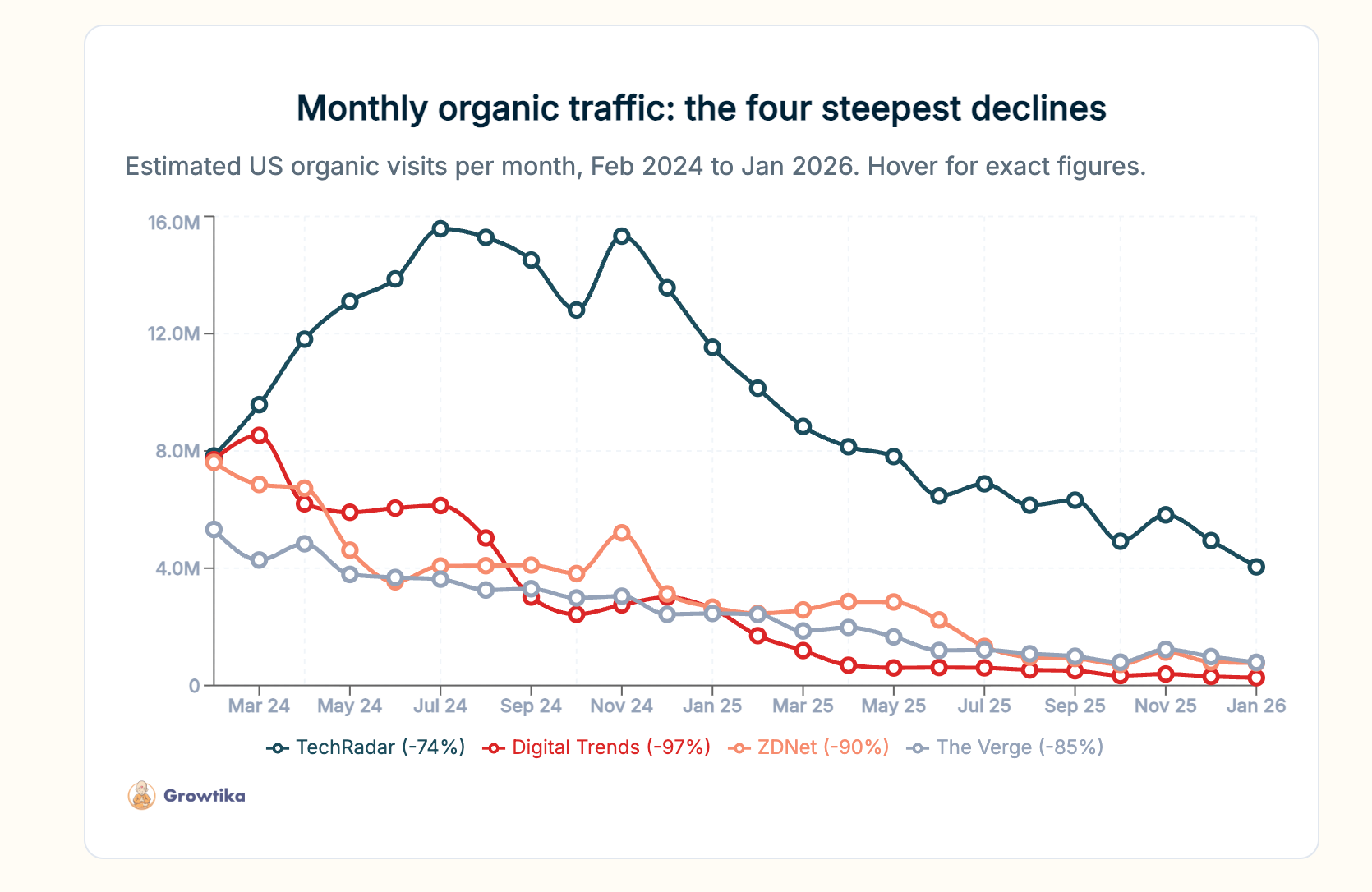
But beyond the raw numbers, something else jumped out at me. For years, publishers have been consolidating, buying up sites, distressed or not, in order to roll their traffic up into one big package for easier ad sales. But if tech media is on the forward edge of the AI Overview wars, then packing your digital army with tech sites seems less like a smart hedge and more like throwing good money after bad.
If tech media is on the forward edge of the AI Overview wars, then packing your digital army with tech sites seems less like a smart hedge and more like throwing good money after bad.
Of the 10 sites tracked in this report, four are owned by Ziff-Davis. Future owns another two of them. Other publishers are reversing course on consolidation. Yahoo (or Yahoo/AOL, if you prefer) seemed to see the writing on the wall, announcing this week that it’s offloading Engadget, much as it did with TechCrunch last year.
That’s why you see so many publications trying to shoehorn paywalls onto their products. They figure if you’ve managed to dodge easy AI answers and arrive at their specific website despite a lack of organic search engine placement, you’re a dedicated enough reader that you might be willing to pay for the privilege.
And as far as media business models go, it’s not the worst idea -- if you’ve invested enough in high-quality content to seal the deal. Only a handful of outlets, from The New York Times to WIRED to The Verge, feel like they’re playing at that advanced level.
The problem there is that you’d have to convince the higher-ups that investing in subscription-worthy content is worthwhile before any actual subscription revenue would materialize. And if there’s one thing media company bosses hate, it’s the idea of paying for something up front with no guarantee of a return.
I continue to stand by my three primary talking points on the current media ecosystem. 1. None of the current business models really work at scale (and I don’t have any great ideas for new ones); 2. Small pubs or individual content creators can find a path through direct newsletter or similar audience acquisition; and 3. The next great battle will be to become the news source most-cited by AI, but how you monetize that real estate remains to be seen.
[Header photo by ashutosh nandeshwar via Unsplash]
Do editors prefer AI-written articles?
Sounds like a crazy question to ask, no? But this Semafor article quotes AP Senior Product Manager for AI Aimee Rinehart as saying, “There are many — and I mean MANY — editors who would prefer an AI-written article to a human-written one.”
That’s the next logical defense of programs like the Cleveland Plain Dealer’s, where reporters are asked to upload their notes to an AI system that drafts an article from them. The plan has been much-derided, but it also has its defenders, including the CPD’s editor, who said the system gave reporters the equivalent of an extra workday per week... because they’re not tied up actually writing the first drafts of their articles.
I can’t say there isn’t a kind of cold logic to this scheme. Maybe we’ll all end up there eventually. But I know that even in the relatively mundane waters of consumer tech reviews, when I’m talking to a source, attending a press event, or testing a product, I’m concurrently writing that first draft in my head, organizing my quotes, experiences, and data into what I think will create the most compelling narrative. Uploading notes to an AI is never going to produce the same story you’d write, especially if the AI is focused on maximum clickability rather than what I often refer to as “the gig”—tell good stories and make the reader feel their time was well-spent.
What AI is actually good for
I’m actually much more pro-AI than you’d think from reading this newsletter. I especially like it for tech support walkthroughs, where I’d otherwise be sifting through various outdated online guides, trying to find a use case similar enough to follow.
Case in point: I’m currently setting up a UGREEN NAS (the DXP6800, if you’re curious), and, not being a huge networking expert, I used Claude as my step-by-step companion to walk through the hardware and UGOS software setup.
It didn’t know everything, but it was pretty spot-on most of the time. The biggest benefit came from grabbing screenshot after screenshot of the software setup and feeding them to Claude to help me configure things the way I wanted (for example, with six drive bays, I went with RAID 6, giving me plenty of capacity, but better protection than RAID 5).
That’s all to say, AI is here. And it’s useful. But it should be doing more NAS setup hand-holding and less writing news articles. Or at least that’s one old reporter’s opinion.
Meet MacBook Neo

Apple did an uncharacteristic thing this week — unveil their decidedly non-premium MacBook. The new MacBook Neo starts at $599 with a step-up model at $699, making it possibly the least expensive laptop Apple has ever made. How did Apple make the math work? by replacing the normal M-series computer chip with an A18 Pro iPhone chip.
You can read my initial hands-on impressions of the new MacBook Neo over at Micro Center News.
The Cheat Sheet
Read my NYT-reviewed gaming history book: The Tetris Effect
Play my tabletop game, Techlandia!
Threads: threads.net/@danack
Bsky: danackerman.Bsky.social
LinkedIn: linkedin.com/in/danackerman
TikTok: tiktok.com/@danacknyc
YouTube: youtube.com/danackerman
MC News: microcenter.news
Regarding the so-called AI overview apocalypse, I do read them, but I also navigate to the cited websites to see what I can learn about whatever I'm researching too. I do so for several reasons 1) To verify what I see in the overview 2) To support the sources of the information I've just received, and 3) To learn if the source(s) include any additional useful information regarding what I'm researching.
This is something I recommend anytime the topic comes up, because if we no longer support the quality sources of the information we want and need, it won't be long before AI runs out of quality sources of information, and thus denigrating the quality of the Internet as a whole, for all of us!
With all this said, I'm left with the question of "Why haven't you came out and strongly included this suggestion in this item!?", if you're as genuinely concerned about the direction things seem to be taking!
Ernie